Beyond the LDC Label: Nepal’s New Era as a Developing Nation
Nepal has officially shed its "Least Developed Country" (LDC) status. On November 24, 2026, after over five decades in the LDC category, Nepal has formally transitioned into the ranks of "Developing Countries." This milestone is not just a part of UN nomenclature, rather an achievement for the nation that has gone through different political shift in short period of time with earthquakes and other several pandemics.
A Journey of Resilience
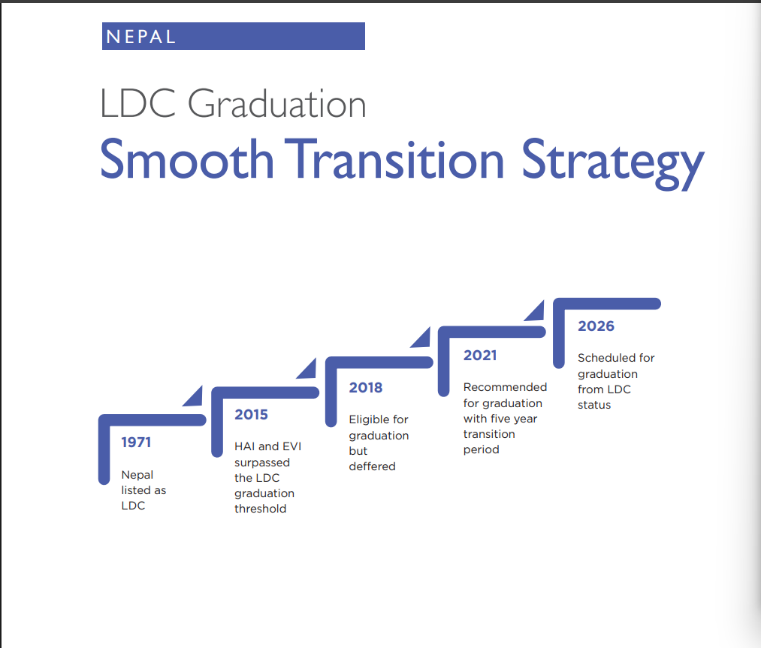
Nepal’s path to graduation has been unique. Unlike many peers, Nepal met the graduation criteria primarily through its progress in human capital and environmental resilience rather than sheer income growth. By consistently exceeding thresholds in the Human Assets Index (HAI) and the Economic and Environmental Vulnerability Index (EVI), Nepal proved that development is about more than just the balance sheet it’s about the health, education, and stability of its people.
The Skeptic’s View: Is Nepal Actually Ready?
While the official data suggests a victory, many economists warn that Nepal is "graduating with a weak pulse." The transition is a stress test of whether the country can sustain growth without the crutch of international support. Here is a critical breakdown of why some argue the graduation might be premature:
1. The "Income-Poor" Graduation Paradox
Nepal is making history for the wrong reason: it is the first country to graduate without meeting the Gross National Income (GNI) threshold of $1,222 (based on 2021 reviews).
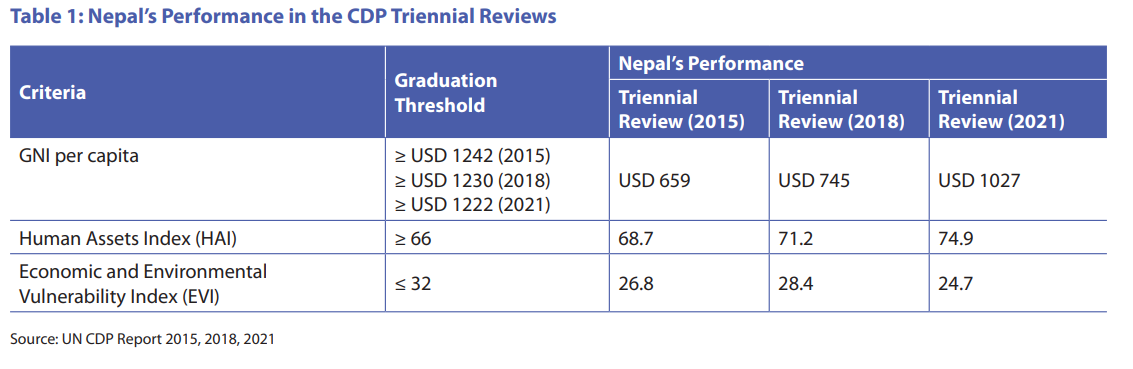
- The Risk: We have achieved graduation through social indicators (Health and Education), but our pockets are still relatively empty. Graduation usually happens when a country is economically "overflowing"; Nepal is graduating while still heavily reliant on external factors.
- The Bottom Line: Without a higher GNI, the country lacks the domestic capital to replace the loss of concessional (low-interest) loans that will disappear after 2026.
2. The Remittance Trap
Critics argue that Nepal’s "Human Assets" (HAI) look good on paper partly because of the money sent home by millions of migrant workers.
- The Vulnerability: Our economy is not built on internal production but on the export of labor. If global oil prices drop or geopolitical tensions rise in the Gulf, Nepal’s primary "engine" stalls.
Structural Weakness: Real graduation should be fueled by domestic jobs. Currently, we are a "Developing Nation" that cannot yet employ its own youth.
3. The "Cliff Effect" on Exports
Nepal’s export sector—specifically garments, knotted carpets, and pashmina—is about to lose its Duty-Free, Quota-Free (DFQF) access.
- The Impact: Once we lose the LDC-specific Generalized System of Preferences (GSP), our products will become 3% to 5% more expensive overnight in European and American markets.
The Critical Failure: Despite knowing about this graduation for a decade, Nepal has not yet significantly improved its "Ease of Doing Business" or lowered the cost of electricity and transport to make our goods competitive without subsidies.
4. Climate Vulnerability vs. Financial Loss
As a "Developing Country," Nepal may lose access to certain LDC-exclusive climate funds.
The Irony: Nepal remains one of the most disaster-prone countries in the world. Losing "most-vulnerable" status at the UN might lead to a decrease in technical grants just as the climate crisis accelerates.
Turning Risks into Opportunities
- The National Planning Commission’s Smooth Transition Strategy (STS) has been the roadmap for this moment. By focusing on industrialization and energy exports specifically hydroelectricity to India and Bangladesh, Nepal is diversifying its revenue streams.
The graduation also serves as a powerful signal to the world. "Nepal is no longer a country defined by its needs, but by its potential," says a senior economist at the National Planning Commission. This new status is expected to boost investor confidence, attracting much-needed Foreign Direct Investment (FDI) and positioning Nepal as a reliable partner in the global supply chain.
Verdict: Can Nepal make it?
The honest answer: Yes, but only with a radical shift in governance.
Nepal cannot "export" its way out of this with traditional goods alone. The path to success requires three non-negotiables:
- Energy Diplomacy: Moving from being a "potential" hydropower giant to a "functional" one that earns billions in hard currency from India and Bangladesh.
- Digital Export: Leveraging our youth in IT and services, which are less affected by physical trade barriers and tariffs.
Fiscal Discipline: Moving away from "Aid Dependency" to "Investment Attraction." The government must stop viewing FDI (Foreign Direct Investment) with suspicion and start seeing it as the only ladder available.
Final Thought:
Graduation is not a guarantee of prosperity; it is merely the removal of training wheels. If Nepal doesn't start pedaling harder through industrial reform, it risks becoming a "Developing Country" that remains stuck in a cycle of low growth and high migration.
As we look toward the 2030 Sustainable Development Goals, the focus now shifts to sustainability. Graduation is not a finish line; it is a starting block. To thrive, Nepal must continue to invest in its digital economy, modernize its agriculture, and ensure that the benefits of this new status reach the remote villages of the Karnali as much as the bustling streets of Kathmandu.
Today, Nepal stands tall. The "LDC" label is gone, replaced by the responsibilities and rewards of a developing nation. The journey was long, but for the people of Nepal, the climb is only beginning.
Article by: Abhaya Karki